Racetrack Bias Evolution: Seasonal Shifts and Their Impact on Betting Markets
Written by Sage Klein · Sep 19, 2026

Racetrack Bias Evolution: Seasonal Shifts and Their Impact on Betting Markets
Track bias refers to consistent advantages or disadvantages that certain parts of a racetrack offer to horses based on their running styles or positions, and these patterns change as a season progresses because of weather cycles, maintenance schedules, and surface wear. Data from multiple racing jurisdictions shows that early season biases often favor inside rails after winter rains compact the ground, while later months bring wider paths into play once grass regrowth and drier conditions alter footing. Observers note that these shifts occur gradually, allowing bettors who track daily timing and sectional data to adjust their models before odds reflect the new reality.
Core Components of Track Bias
Rail bias emerges when the innermost lane packs down harder than outer lanes, creating firmer ground that suits front-runners, whereas moisture retention in outer lanes can slow horses that race wide. Surface composition plays a role too, since clay-heavy tracks hold moisture differently than sandy mixes, and researchers from the University of Melbourne's equine studies group documented how these material differences produce measurable speed variances of up to 1.2 seconds per 1000 meters across lanes. Wind direction and sunlight exposure further modify bias daily, yet the cumulative effect across weeks creates seasonal trends that betting markets eventually price in through adjusted place and win odds.
How Bias Evolves Month by Month
Pre-season preparation typically leaves tracks with even surfaces, but the first month of racing often reveals an inside bias because heavy rollers used during renovation create a firmer crown near the rail. By mid-season, increased traffic and selective watering shift the advantage outward as trainers avoid the worn rail during workouts, and data compiled by Equibase shows that rail win percentages drop from 38 percent in month one to 29 percent by month four in flat racing circuits. Late season brings another transition when autumn rains soften outer lanes faster, returning some advantage to inside runners while introducing a new speed-favoring bias on teh back straight where drainage patterns differ.
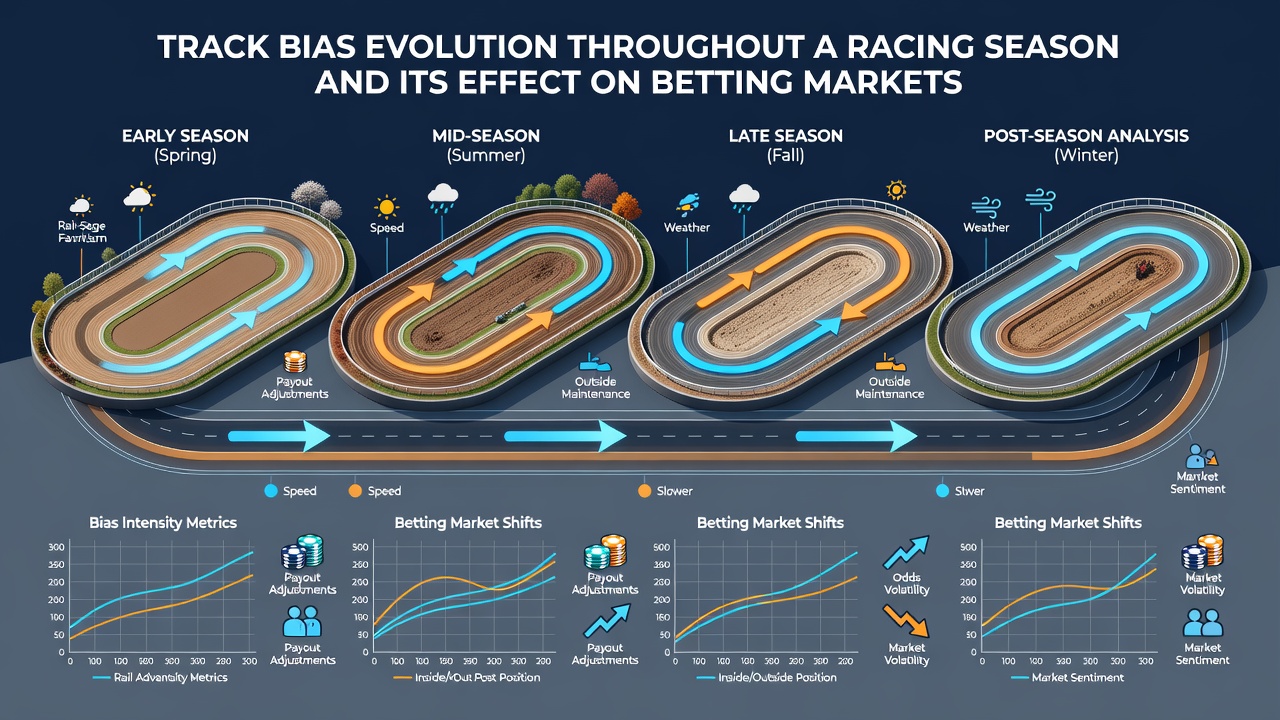
Maintenance crews respond to these changes by adding sand or harrowing specific lanes, yet the timing of interventions creates temporary windows where bias becomes pronounced. One documented pattern in Australian provincial tracks demonstrates that bias strength peaks around the 60-day mark before crews implement corrective aeration, after which the advantage dissipates over the following three weeks. Bettors monitoring these interventions through official track reports gain an edge because market odds adjust more slowly than the actual surface conditions allow.
Effects on Betting Market Dynamics
Bookmakers and exchange platforms incorporate historical bias data into their pricing algorithms, but real-time adjustments lag when seasonal transitions accelerate. Early season inside bias inflates prices on rail runners, while late season wide bias compresses those same odds and lengthens prices on closers. Industry reports from the Australian Racing Board indicate that market overrounds increase by 0.8 percent during bias transition periods because oddsmakers widen margins to account for uncertainty in pace and lane data. Sharp bettors exploit this lag by focusing on horses whose running styles align with emerging biases before the market fully incorporates updated sectional averages.
Exchange markets show even greater sensitivity because liquidity concentrates on popular selections, and bias shifts can create temporary mispricings in place markets where each-way support moves faster than win odds. Data from Canadian thoroughbred tracks reveals that place pool payouts deviate by an average of 4.7 percent from fair value during the first two weeks after a documented bias change, giving arbitrage opportunities to those who combine speed figure updates with bias tracking software.
Regional Variations and Data Sources
Northern hemisphere tracks experience more pronounced late-season bias reversals because rainfall patterns intensify after August, whereas southern circuits see steadier evolution driven by irrigation schedules. The Jockey Club's annual surface reports document that North American dirt tracks lose their early inside bias faster than turf courses because synthetic additives used in dirt maintenance accelerate lane equalization. European observers have recorded similar patterns on grass, where September conditions often produce a pronounced outside bias on courses that receive heavy summer use.
Conclusion
Track bias evolves through predictable stages tied to weather, maintenance, and traffic patterns, and these changes directly influence how betting markets set and adjust odds throughout the season. Bettors who integrate daily sectional analysis with historical bias data can identify value before prices fully reflect surface shifts, while operators continue refining models to reduce lag during transition periods. The interplay between physical track conditions and market response remains a measurable factor that shapes outcomes across flat and jump racing calendars.